Plain language
What this result means
A useful antimicrobial peptide library needs promising individual sequences and enough variety to explore different candidates. The team treated the final library as a joint selection problem: generate a larger pool, assess its candidates, and assemble a set that balances predicted quality with coverage of peptide space. The official result provides an independent competition evaluation of that submitted set.
- The organizer report identifies the entry as 84912 Vadim Borisov: rank 15, score 23.21 ± 0.20. The uncertainty is the standard deviation across five disjoint evaluation blocks.
- The competition received 61 submissions. Forty entries were ranked; four eligible organizing-team entries were scored separately without ranks.
- The team’s wrap-up reports 50,000 unique sequences and a top-100 subset, with byte-identical FASTA outputs across repeated CPU-only submission-generation runs.
- An evaluator audit exposed a reversed conformity objective and a weighting error. After correcting the evaluator, removing a forced diversity quota improved the internal top-100 evaluation by about 83%.
Visual notes
How to read the result
Result table
15th of 40 ranked submissions in the AMP Challenge.
| Metric | Reference | Team result | Comparison | Context |
|---|---|---|---|---|
| Official competition rank | 40 ranked entries | 15th | organizer ranking | Table 2 · entry 84912 |
| Official aggregation score | 0–100 scale | 23.21 ± 0.20 | higher is better | mean ± SD · five 10,000-sequence blocks |
| Submitted library | 50,000 required | 50,000 sequences | eligible and ranked | top-100 is a subset of the library |
| Internal Phase 2 score | 0.954 | 1.747 | +83.1% | team-reported held-out evaluation · separate scale |
| Internal worst-strain potency score | 1.161 | 1.610 | +38.7% | after removing the top-100 diversity quota |
Method
How it was found
A 37.9-million-parameter conditional peptide language model follows a three-stage curriculum: 2 million UniParc peptides, 837,000 AMPSphere metagenomic peptides, and 47,000 curated antimicrobial peptides. GRPO then rewards the weakest of several potency signals, encouraging agreement across predictors. The final library is assembled jointly rather than by taking the highest individual scores alone.
- Condition generation on peptide length and net-charge buckets, and sample from a portfolio of model checkpoints.
- Rank candidates with conservative bootstrap-ensemble estimates for antimicrobial potency and hemolysis-related properties.
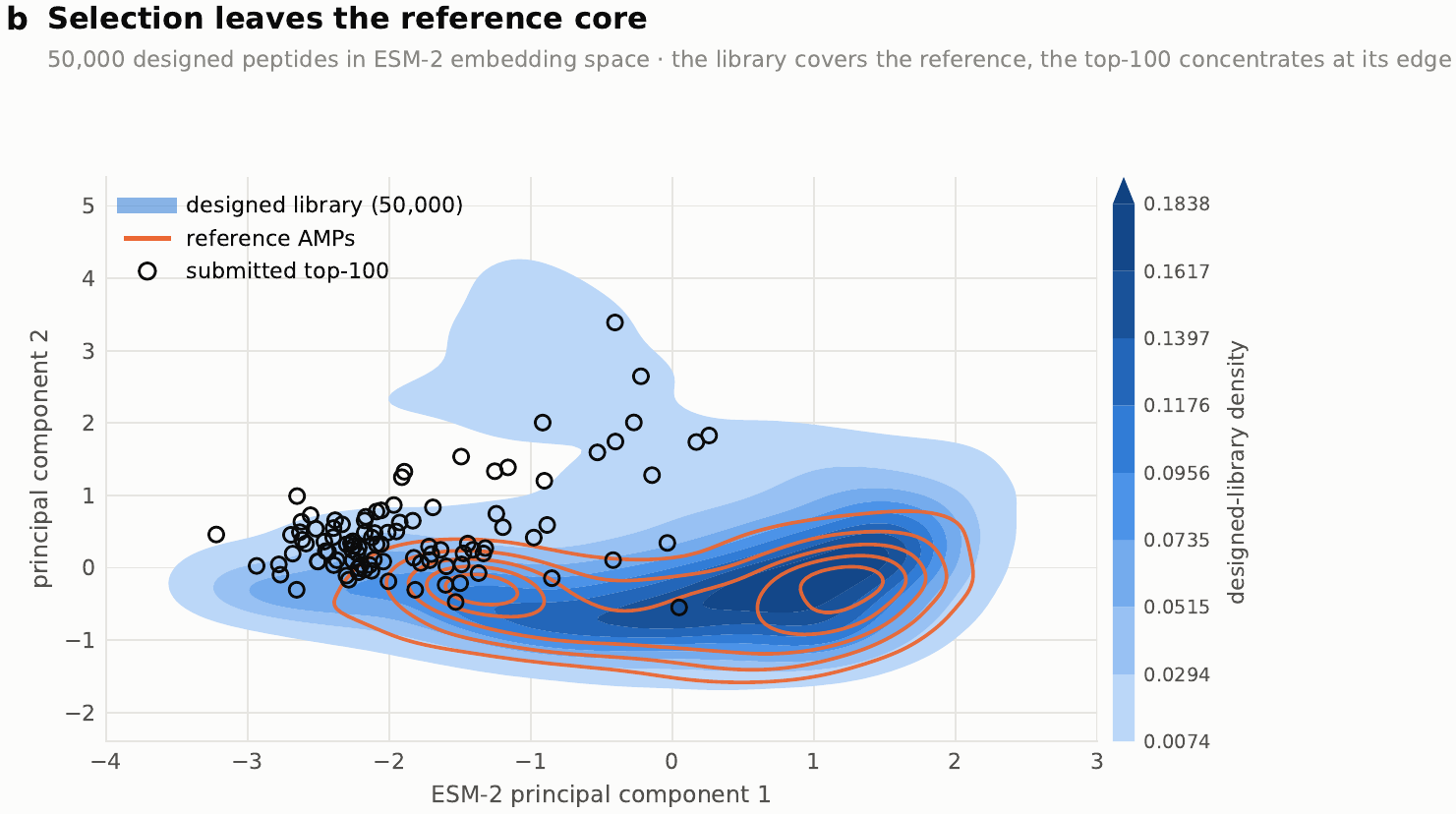
- Run 400,000 set-level swap iterations to match the reference distribution in ESM-2 embedding space while retaining promising candidates.
- Select the top-100 without the hard cluster quota that the internal audit found was admitting weaker candidates.
Verification
How it was checked
The independent ranking comes from Table 2 of the organizers’ AMP Challenge – Aggregation Score report. Its metric weights realism, activity, and diversity equally and averages five non-overlapping blocks covering the complete submitted library. The wrap-up separately reports corrected evaluator agreement with seqme, ablation checks, sequence-compliance checks, and deterministic reproduction. Those pipeline checks and internal gains are team-reported; this website review checked the published sources rather than rerunning training, generation, or scoring.
Scope
What is not being claimed
The official aggregation score is an in silico benchmark, not a wet-lab result. The internal Phase 2 improvement is a selector comparison on a different metric and is not an official leaderboard gain. The wrap-up flags unusually high positive charge in the top-100 and possible hemolytic risk, and notes limited predictive correlation on newly designed peptides. Experimental potency, toxicity, and clinical usefulness remain unestablished by these sources.
References
Baseline sources
Citation
How to cite
Vadim Borisov. "Peptide Antimicrobial Library by Set-Level Selection." Numaro Research Report NUMARO-2026-023, 2026.
@techreport{numaro2026AntimicrobialPeptideLibrary,
  title = {Peptide Antimicrobial Library by Set-Level Selection},
  author = {Vadim Borisov},
  institution = {Numaro},
  number = {NUMARO-2026-023},
  year = {2026},
  url = {https://numaro.tech/research/antimicrobial-peptide-library-2026/}
}