The short answer
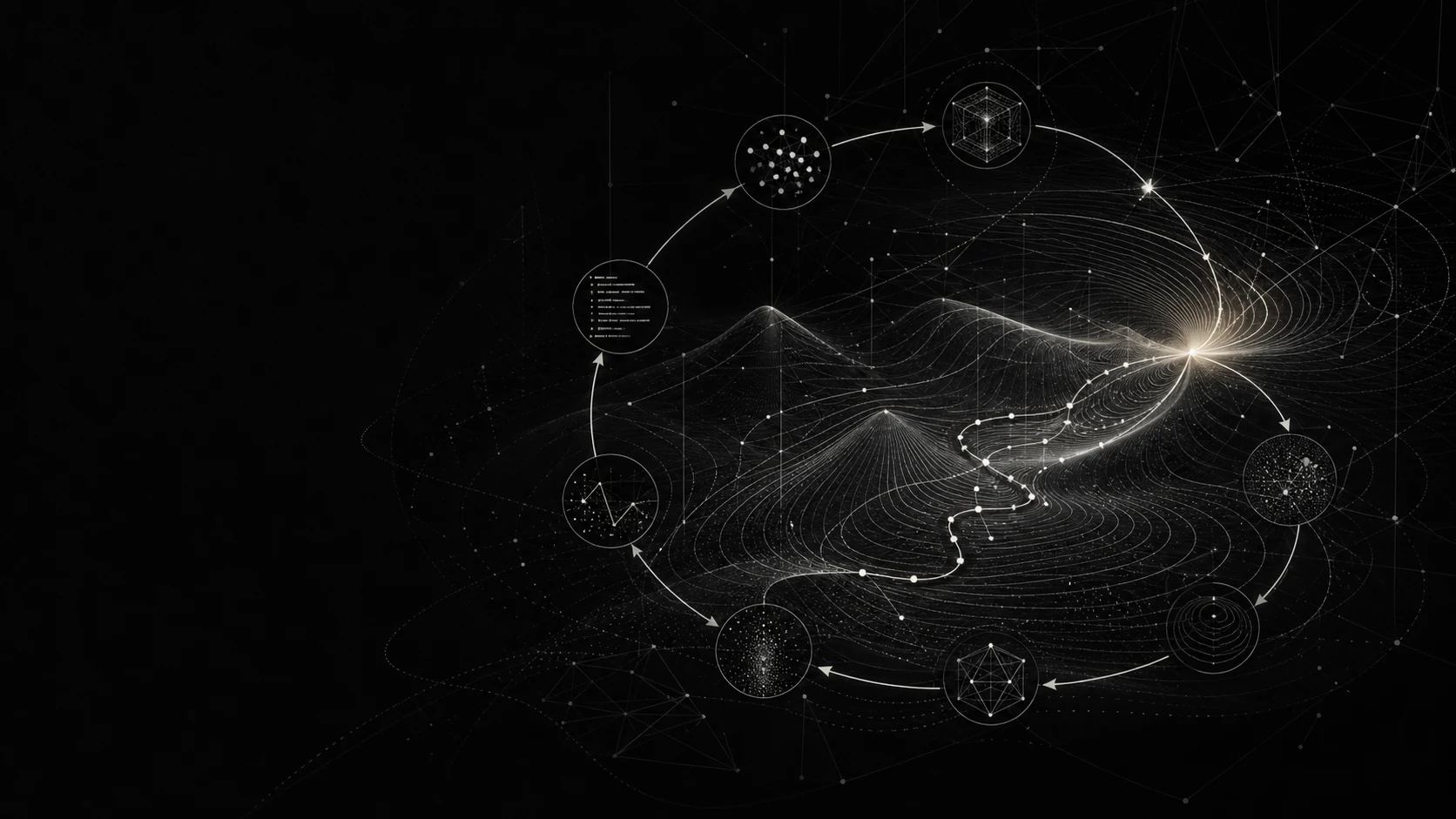
Autoresearch is a closed loop between reasoning and reality.
An ordinary AI exchange ends when the model returns text. An autoresearch campaign continues: it chooses a direction, creates the tools required to investigate it, observes what happens, and revises the next move from evidence.
That difference sounds small, but it changes the unit of work. The output is no longer one response. It is a research campaign with a target, a budget, an experiment history, and a memory of what has already been tried.
The shape of a campaign
Most experiments fail. The frontier is what survives.
A useful campaign does not need every idea to work. It needs cheap ways to reject weak ideas, reliable ways to verify improvements, and enough memory to keep the search from circling back to the same failures.

Notice the staircase. Progress arrives unevenly. A new tool can open a region of the search space, several iterations can produce nothing, and a verifier can later remove an apparent gain. Autoresearch is designed around that jagged reality rather than a smooth story of inevitable improvement.
The loop
Five moves, repeated.
Implementations differ, but a complete autoresearch system has to close the same basic loop from problem to evidence and back again.
- 01
Frame the problem
A campaign begins by turning an open question into a measurable target. The constraints, baseline, budget, and stopping rule must be explicit enough that a machine can tell progress from motion.
- 02
Explore possible routes
Agents search papers, inspect previous attempts, and propose genuinely different hypotheses. The point is not to generate a long list. It is to identify a small set of directions with testable consequences.
- 03
Build what the idea needs
A hypothesis may need a solver, simulator, verifier, dataset, benchmark harness, or new search procedure. Autoresearch writes those tools instead of treating their absence as the end of the answer.
- 04
Run, measure, and challenge
Experiments meet the baseline. Critics look for leakage and false improvement. Weak routes are closed; promising ones receive more compute and sharper instruments.
- 05
Retain the evidence
The result, code, traces, and dead ends become campaign memory. The next pass begins with everything the previous pass paid to learn.
The boundary
Not a chatbot with more tokens.
Language models are part of the system, but longer reasoning alone does not make autoresearch. The boundary is action and verification: did the system change the state of the investigation, and can it check what that change means?
Many roles, one objective
Why use more than one agent?
Research contains conflicting jobs. The agent inventing a direction should not be the only agent deciding whether it worked. The agent writing a solver should be able to ask another agent for a checker. Separating roles creates useful disagreement and lets each part of the campaign carry a narrower responsibility.
- Explorermaps papers, baselines, and neighboring formulations
- Inventorturns possibilities into explicit, testable hypotheses
- Buildercreates the solver, experiment, and instrumentation
- Critictries to break the claim before anyone trusts it
- Operatorallocates compute and expands the surviving routes
The aim is not a crowd of agents. It is a chain of accountable work.
The compounding part
The next campaign should not start from zero.
A winning answer is only one asset. The campaign also produced working theories, solvers, verifiers, search procedures, datasets, traces, and negative results. Keeping those artifacts changes what future agents can attempt and how quickly they can tell whether a familiar-looking route is actually new.
This is why memory in autoresearch is more than retrieval. It is accumulated research infrastructure. A failed route with a precise explanation can be nearly as valuable as a success because it removes a whole branch from future search.
What counts
A result is a claim with an evidence trail.
Numaro publishes the parts needed to inspect the work: the baseline, method, checker, limits, source material, and the exact claim. These are selected examples from the public results ledger.
A 22-year mathematical record, broken
Numaro raised the rigorous square-lattice self-avoiding-walk lower bound, and the result was accepted into Optimization Problems.
22 years between rigorous improvementsAI performanceFaster GPU kernels for AI workloads
Selected small and medium batched matrix multiplications on an NVIDIA L40S, measured against torch.bmm / cuBLAS.
2–4.5× kernel speedupChip designAn AI-discovered chip-placement algorithm
Relax-and-Gate lowers the 17-circuit mean proxy below the published challenge winner, with every placement legal.
0.93663 mean placement proxyDiscrete geometrySpherical-code record campaign
More than 11,000 verified table records across dimensions 3–32.
11,000+ verified recordsAlgebraic complexityMatrix-multiplication schemes
Forty-five Brent-certified schemes reduce additions at fixed multiplication rank.
45 records