Plain language
What this result means
Fast matrix multiplication is not only about the number of multiplications. A rank-r scheme still has to form input sums and output combinations around those multiplications. This result lowers that surrounding add/sub work for specific Brent-valid schemes without changing the rank.
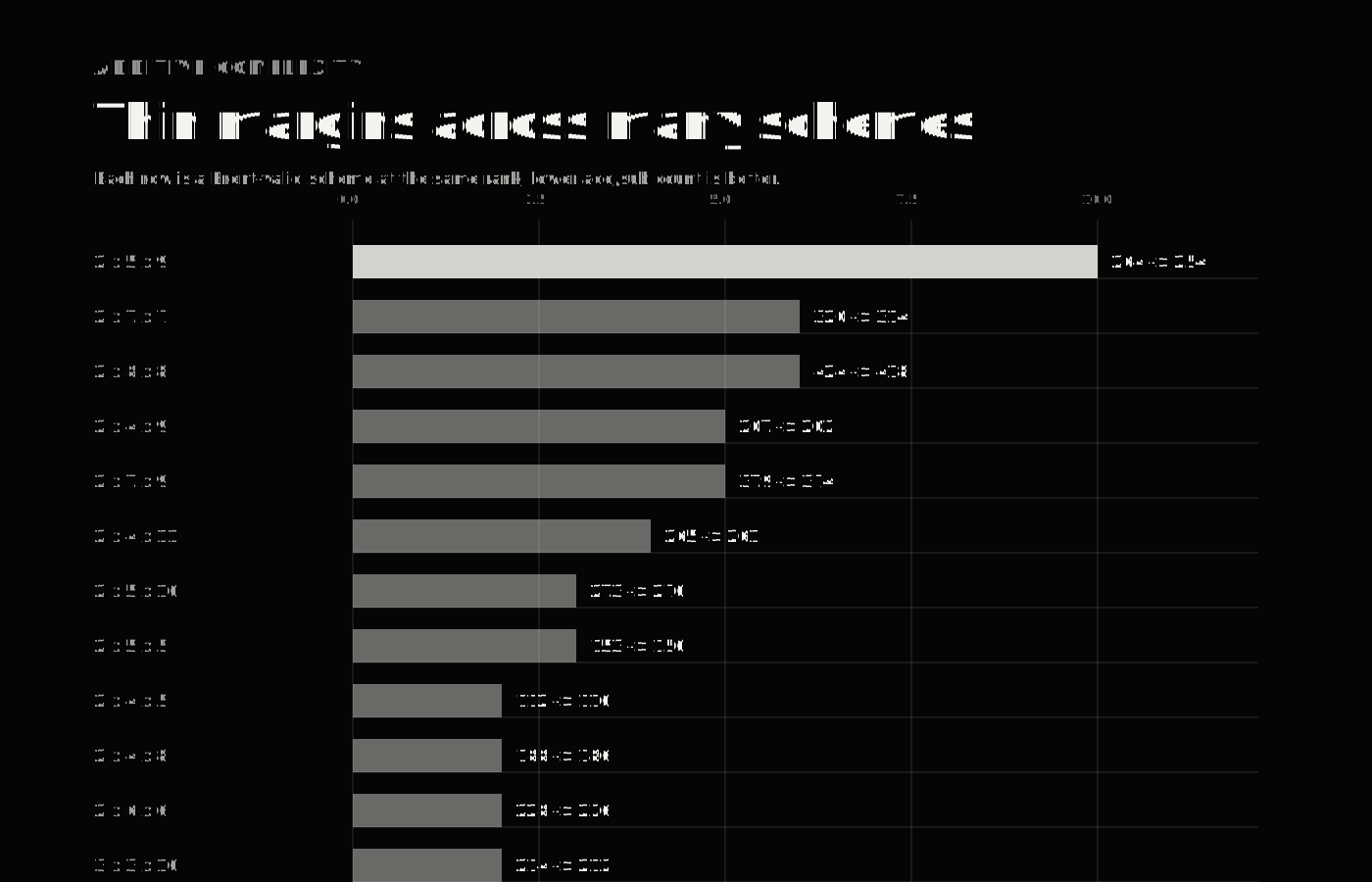
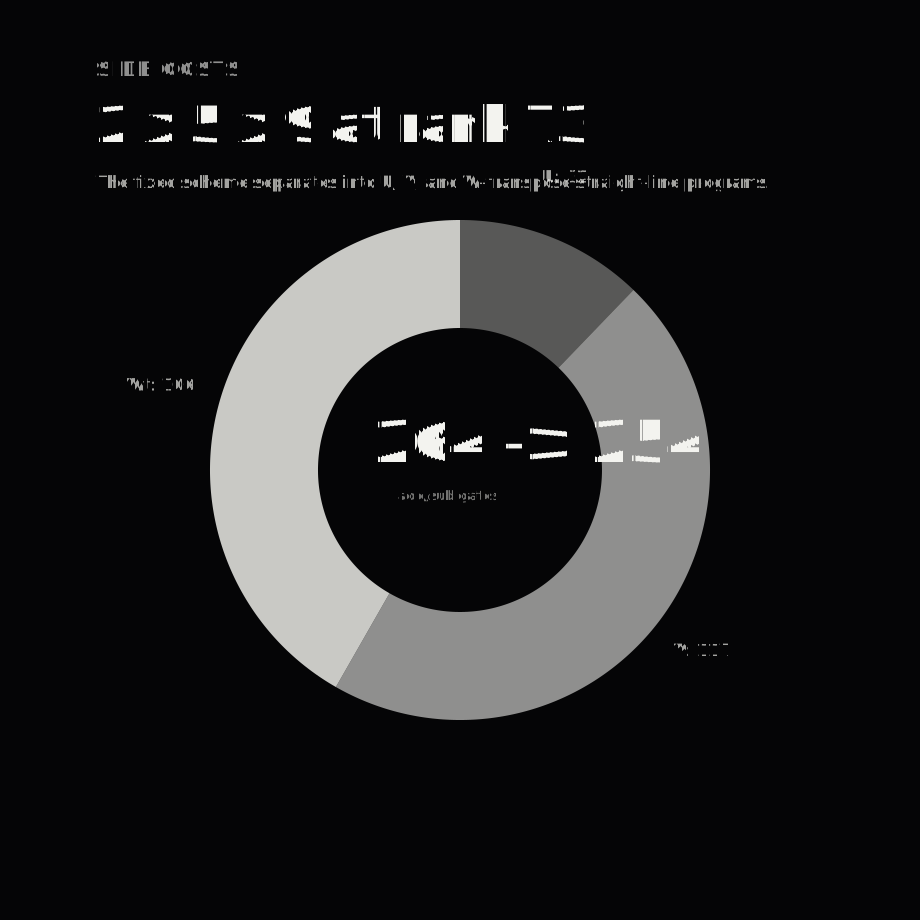
- The largest representative margin is <2,5,9>: 264 additions down to 254 at rank 73.
- The expanded ledger contains 45 fixed-rank records and saves 135 additions in total.
- Most of the gain comes from input-side matrices that are perfectly peelable: the exact lower bound equals the constructed circuit count.
- Several candidate wins were dropped after rerunning Perminov's own reducer at higher effort. Only strict beats over that stronger baseline are kept.
Visual notes
How to read the result
Result table
Forty-five Brent-certified schemes use fewer additions at the same rank.
Method
How it was found
For each fixed scheme, the total addition count separates into the costs of U, V, and W-transpose. The campaign minimized those sides independently and kept the best reconstructable circuit per side.
- Reproduced the FMM/Perminov and plinopt baselines before claiming any improvement.
- Used exact peeling SLPs where F(M) equals the number of distinct non-trivial rows up to sign.
- Applied a Tellegen output map when computing W first and transposing the program was cheaper.
- Extracted and reused Perminov's own best per-side reductions for dense sides, instead of forcing our method everywhere.
Verification
How it was checked
verify.py checks the Brent tensor identity over the integers, runs randomized matrix products, reconstructs every side from the stored SLP, recounts gates, and asserts the new total is below the old total.
Scope
What is not being claimed
These are best-known additions for specific schemes at fixed rank. They are not proofs of globally minimal additive complexity for each matrix format, and XOR-only GF(2) counts are a different metric.
References
Baseline sources
Citation
How to cite
Numaro AI Autoresearch Team. "New best-known additive complexities for fast matrix-multiplication schemes." Numaro Research Report NUMARO-2026-002, 2026.
@techreport{numaro2026MatrixMultiplicationAdditive,
  title = {New best-known additive complexities for fast matrix-multiplication schemes},
  author = {Numaro AI Autoresearch Team},
  institution = {Numaro},
  number = {NUMARO-2026-002},
  year = {2026},
  url = {https://numaro.tech/research/matrix-multiplication-additive-complexity-2026/}
}