Plain language
What this result means
Self-avoiding walks are a basic model of polymers and critical phenomena. Their exact square-lattice growth constant remains unknown. Progress depends on converting very large exact enumerations into inequalities that survive independent checking; here the improvement comes from extending the same rigorous framework to wider lattice spans.
- The span-17, length-260 run traversed about 5.6×10^8 states and 8.7×10^8 transitions using exact integer arithmetic and Chinese remaindering.
- Secondary bounds μ ≥ 2.6265705 at span 16 and μ ≥ 2.6256270 at span 15 both independently clear the previous 2.625622 value.
- Optimization Problems pull request #135 was merged on August 2, 2026, and the value now appears on the public constant page.
The mathematics
From finite walks to an infinite growth rate
counts walks of n nearest-neighbour steps from the origin on the square lattice, with no vertex visited twice. The limit gives their exponential growth rate.
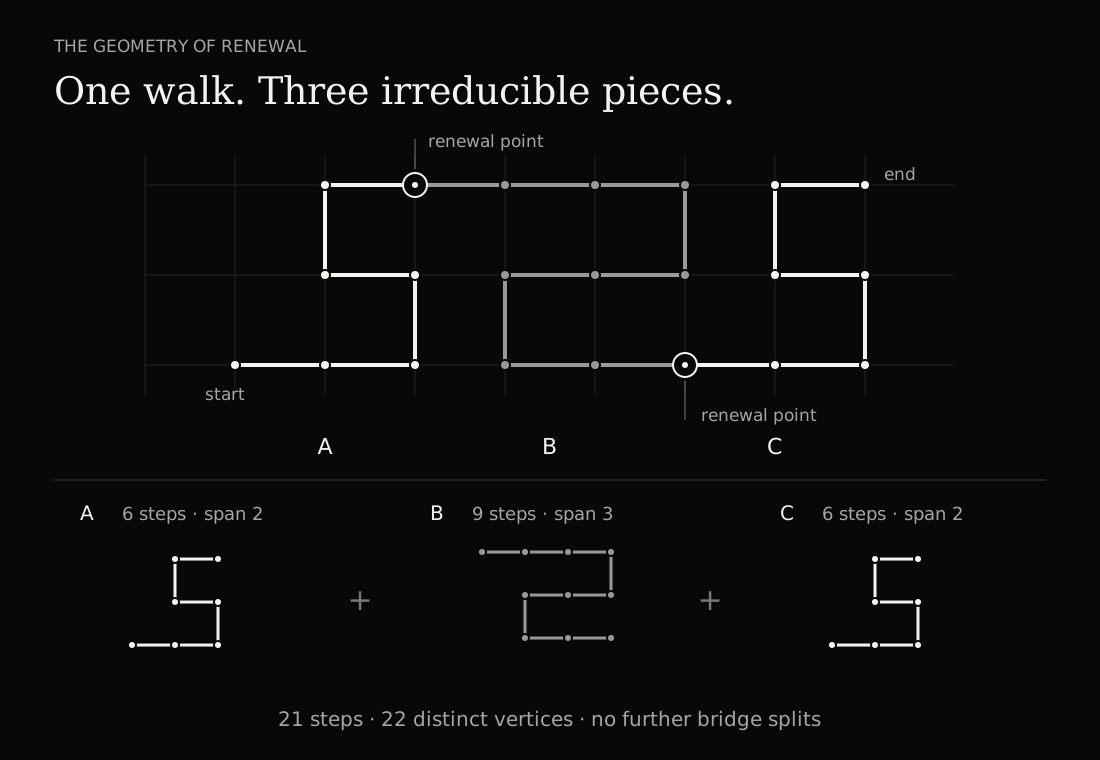
A bridge stays to the right of its start and ends at its rightmost coordinate. Here counts those that cannot be split into shorter bridges. Kesten’s renewal identity links these building blocks to.
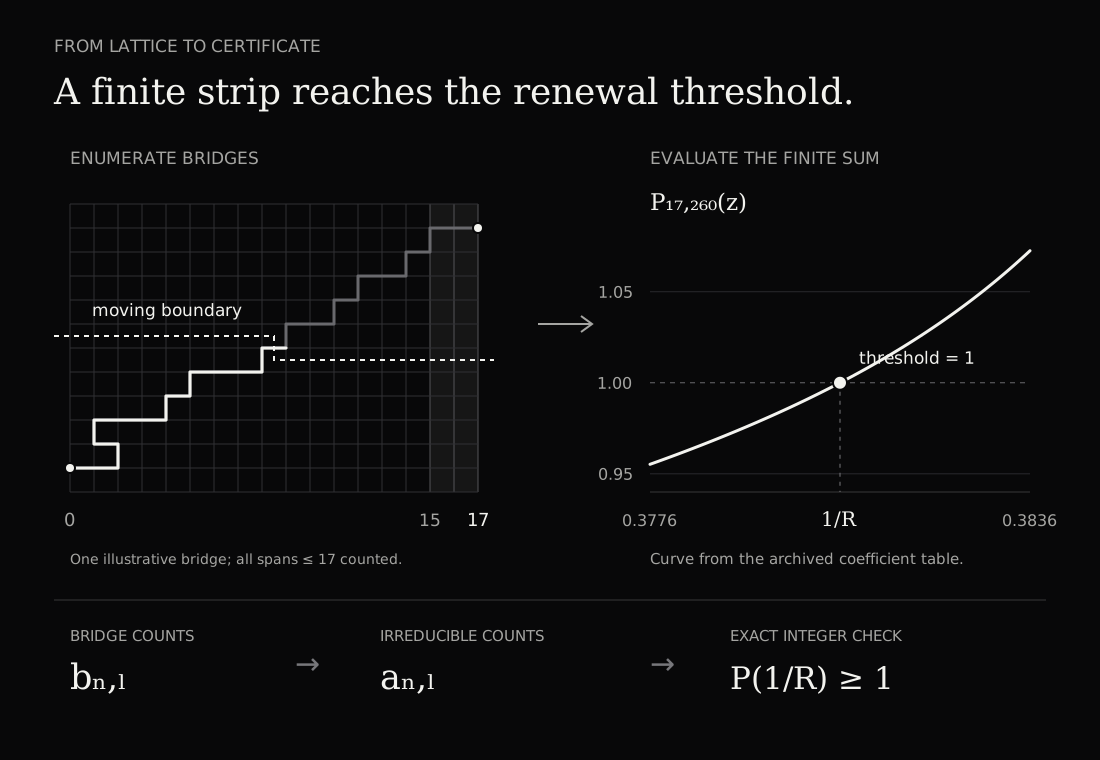
counts irreducible bridges of lengthn and horizontal span . All coefficients are nonnegative: omitting longer or wider bridges only reduces the sum. Reaching 1 already proves the bound.
The renewal argument follows Jensen’s 2004 treatment, equations (3)–(4).
Visual notes
How to read the result
Result table
An exact span-17 enumeration raises a rigorous lower bound that had stood since 2004.
| Cell | Baseline | Numaro | Delta | Note |
|---|---|---|---|---|
| Rigorous lower bound | 2.625622 | 2.627385640… | +0.0017636 | first improvement since 2004 |
| Transfer span | L=15 | L=17 | +2 | length cutoff N=250 → N=260 |
| Exact states | — | ≈5.6×10^8 | enumerated | CRT-backed integers |
| Rigorous upper bound | 2.679193 | 2.679193 | unchanged | the exact constant remains open |
Method
How it was found
The computation enumerates irreducible bridges cell by cell on finite strips, stores the resulting generating-function coefficients exactly, and applies Kesten's renewal criterion to convert the finite sum into a lower bound for μ.
- Reproduced the established irreducible-bridge renewal calculation.
- Extended the finite-lattice transfer matrix through span 17 and length 260.
- Reconstructed large coefficients with Chinese remaindering and checked the renewal inequality using exact integer arithmetic.
- Restricted the same table to spans 15 and 16 for secondary certificates.
Verification
How it was checked
The archived checker validates the exact rational threshold, coefficient hashes, truncation conditions, and the renewal inequality. A local rerun completed every check and printed ALL CERTIFIED. The website verifier checks the published certificate; it does not repeat the original multi-hundred-million-state enumeration.
Scope
What is not being claimed
This improves the rigorous lower bound, not the numerical estimate or the rigorous upper bound, and it does not determine μ exactly. The large enumeration is bound to the certificate by hashes rather than rerun in the lightweight checker.
References
Baseline sources
Citation
How to cite
Numaro AI Autoresearch. "A Certified Transfer-Matrix Lower Bound for the Square-Lattice Self-Avoiding-Walk Connective Constant." Numaro Research Report NUMARO-2026-018, 2026.
Certificate archive: Zenodo, DOI 10.5281/zenodo.21546041.
@techreport{numaro2026SelfAvoidingWalk,
  title = {A Certified Transfer-Matrix Lower Bound for the Square-Lattice Self-Avoiding-Walk Connective Constant},
  author = {Numaro AI Autoresearch},
  institution = {Numaro},
  number = {NUMARO-2026-018},
  year = {2026},
  url = {https://numaro.tech/research/self-avoiding-walk-connective-constant-2026/},
  note = {Certificate archive: Zenodo, DOI 10.5281/zenodo.21546041}
}