Plain language
What this result means
A smaller maximum inner product means a larger minimum angle between the closest pair of points. This is not one lucky configuration: the same strict verifier confirms more than eleven thousand new best-known table records across every dimension from 3 through 32.
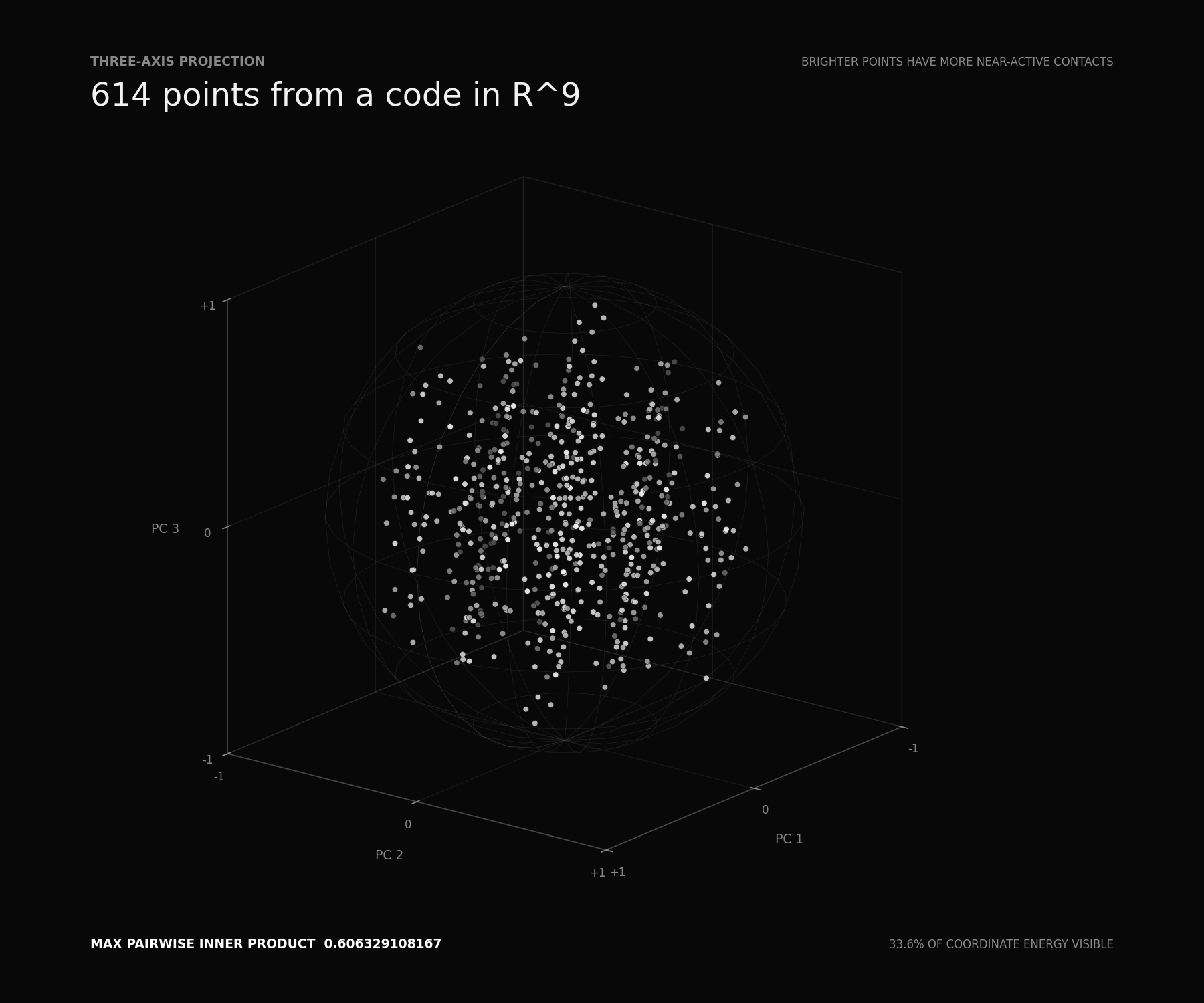
- At (9,614), the deepened coordinate file lowers the maximum inner product by 0.007394768343. Equivalently, the minimum angle rises from 52.1407 degrees to 52.6755 degrees, a gain of 0.5347 degrees.
- At the targeted (26,55) cell, the maximum inner product moves from 0.039999166079 to 0.039998970557, a strict 1.955e-7 gain at the scale where a smooth proxy is too coarse.
- The margin distribution is broad: 80 cells improve by more than 1e-3, 1,021 by more than 1e-4, and 3,453 by more than 1e-5.
- Under the identical attack, 0 of 24 proven-optimal controls moved, and exact-algebraic values such as (9,21)=1/9 held unchanged.
Problem geometry
Spread N points so their closest pair is as far apart as possible
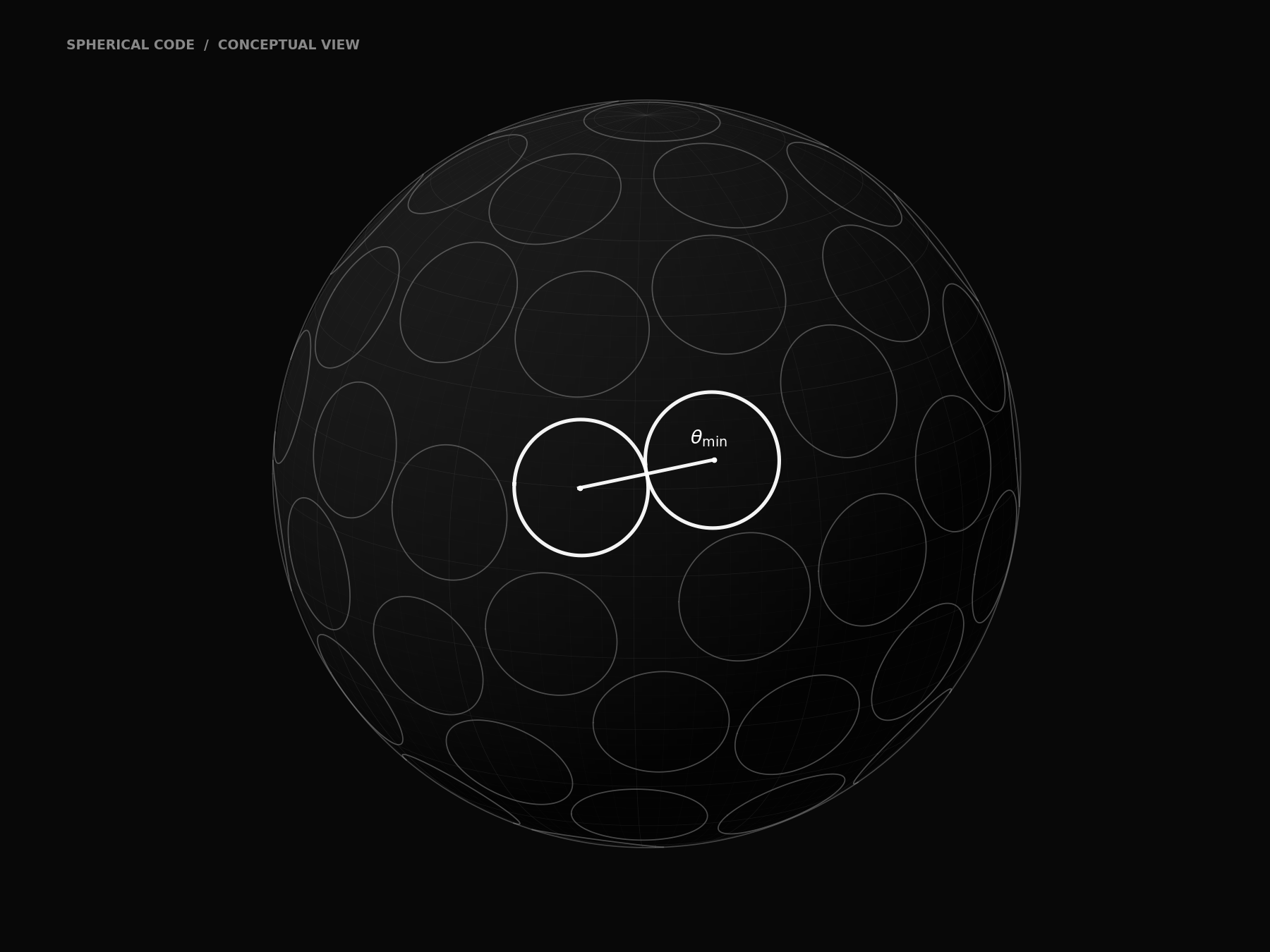
Write for the full configuration: N is the number of points, d is the ambient dimension, and is point i, represented by a unit vector in . On the ordinary sphere . Here means the two-dimensional surface of the unit sphere in : the set of all vectors with . The superscript 2 counts dimensions along the surface, not the three ambient coordinates. The verified record instead lives on , the unit sphere in , which cannot be drawn directly. The hero image is the faithful three-dimensional analogy: equal angular caps stay disjoint only when their centers are sufficiently separated.
Because is decreasing, lowering the largest inner product is exactly the same as increasing the smallest angle. Caps of angular radius then have disjoint interiors, which is the geometry shown above.
The source accounting is exact, not a discrepancy: 10,930 improved cells have printed entries in the site's /plain export, and 74 additional improved cells appear only in its HTML table. Those HTML-only cells were checked against the HTML value and are included in the 11,004 total.
Visual notes
How to read the result
Result table
11,000+ new verified records across dimensions 3–32, with four coordinate-backed examples shown here.
| Cell | Baseline | Numaro | Delta | Note |
|---|---|---|---|---|
| d=9, N=614 | 0.613723876510 | 0.606329108167 | -7.395e-3 | largest coordinate-backed margin (coordinates) |
| d=9, N=615 | 0.613723886311 | 0.606837256245 | -6.887e-3 | adjacent block (coordinates) |
| d=10, N=929 | 0.599853572692 | 0.594793260726 | -5.060e-3 | large-N code (coordinates) |
| d=26, N=55 | 0.039999166079 | 0.039998970557 | -1.955e-7 | small but strict targeted gain (coordinates) |
Table attribution: the uploaded entries are currently shown on spherical-codes.org as “Uploaded by anonymous internet user, 2026.” Attribution to Numaro is pending maintainer review.
Minimax endgame
The descent direction is a convex-hull problem
The feasible set for is , the product of N copies of the unit sphere in . Each pair score is smooth, but their maximum is not: several index pairs can attain the same worst inner product . The active set collects exactly those tied pairs. In numerical work, equality is replaced by a tight active-set tolerance.
Here is the pair gradient projected into the tangent space at , means convex hull, and is the Frobenius norm. The variable ranges over convex combinations of the active gradients; is the one with smallest norm, and is the common steepest first-order descent direction. Hundreds of tied or near-tied contacts are handled together instead of forcing an arbitrary winning pair.
In this equivalent quadratic program, enumerate the active contacts; contains their nonnegative weights; and makes those weights sum to one. Each is one active gradient, while is their Gram matrix under the Frobenius inner product . This simplex QP remains usable when contact degeneracy makes pair-by-pair or sequential linear updates unstable.
Here is the Clarke subdifferential of the nonsmooth objective. A zero minimum-norm subgradient certifies first-order Clarke stationarity: there is no common first-order descent direction. It is a stopping certificate, but not by itself a proof of local or global optimality.
Why a smooth maximum is too coarse
Let list all pairwise inner products. The symbol denotes their log-sum-exp surrogate, with controlling how sharply it approximates the maximum.
For a 55-point code, ; at , the worst-case smoothing gap is about . That is more than four orders of magnitude above the verified gain at , so the final comparison must use the true maximum rather than a softmax surrogate.
Method
How it was found
The campaign combines broad repulsive-energy relaxation with an exact nonsmooth minimax endgame. At tied worst contacts, it computes the minimum-norm Clarke subgradient through a simplex quadratic program, moves in the common tangent-space descent direction, and always scores the true maximum inner product.
- Normalize every vector and define the score as the largest off-diagonal entry of its Gram matrix.
- Use repulsive-energy relaxation, tangent-space moves, and renormalization for broad exploration on the product of spheres.
- Build the tied or near-tied active contact set and solve the minimum-norm convex-hull quadratic program.
- Move along the negative minimum-norm subgradient and stop at first-order Clarke stationarity.
- Carry strong configurations across neighboring N values, then retain only gains above 1e-9 over the strongest available live baseline.
Verification
How it was checked
The campaign verifier writes a beat only after float128 recomputation of the normalized N-by-d coordinate matrix and every off-diagonal Gram entry, with a gain above 1e-9. The current best-per-cell ledger has 11,004 beats: 10,930 against /plain values and 74 against HTML-only table values. The (9,614) example shown here uses the current deepened value 0.606329108167 rather than the stale 0.606345638284 release artifact.
Scope
What is not being claimed
These are 11,004 new verified numerical records for lower bounds on minimum angle, not proofs of globally optimal codes. A zero minimum-norm Clarke subgradient is a first-order stationarity certificate, not a sufficient optimality proof. The cap-covered 3D sphere explains the problem on S^2, while the flagship code lives on S^8; the PCA figure is also a lossy projection. Forty-one explicit coordinate files are retained for a later bulk release, which is not linked from this page yet.
References
Baseline sources
Citation
How to cite
Numaro AI Autoresearch. "11,000+ New Verified Spherical-Code Records from AI Autoresearch." Numaro Research Report NUMARO-2026-015, 2026.
@techreport{numaro2026SphericalCodes2026,
  title = {11,000+ New Verified Spherical-Code Records from AI Autoresearch},
  author = {Numaro AI Autoresearch},
  institution = {Numaro},
  number = {NUMARO-2026-015},
  year = {2026},
  url = {https://numaro.tech/research/spherical-codes-2026/}
}