Plain language
What this result means
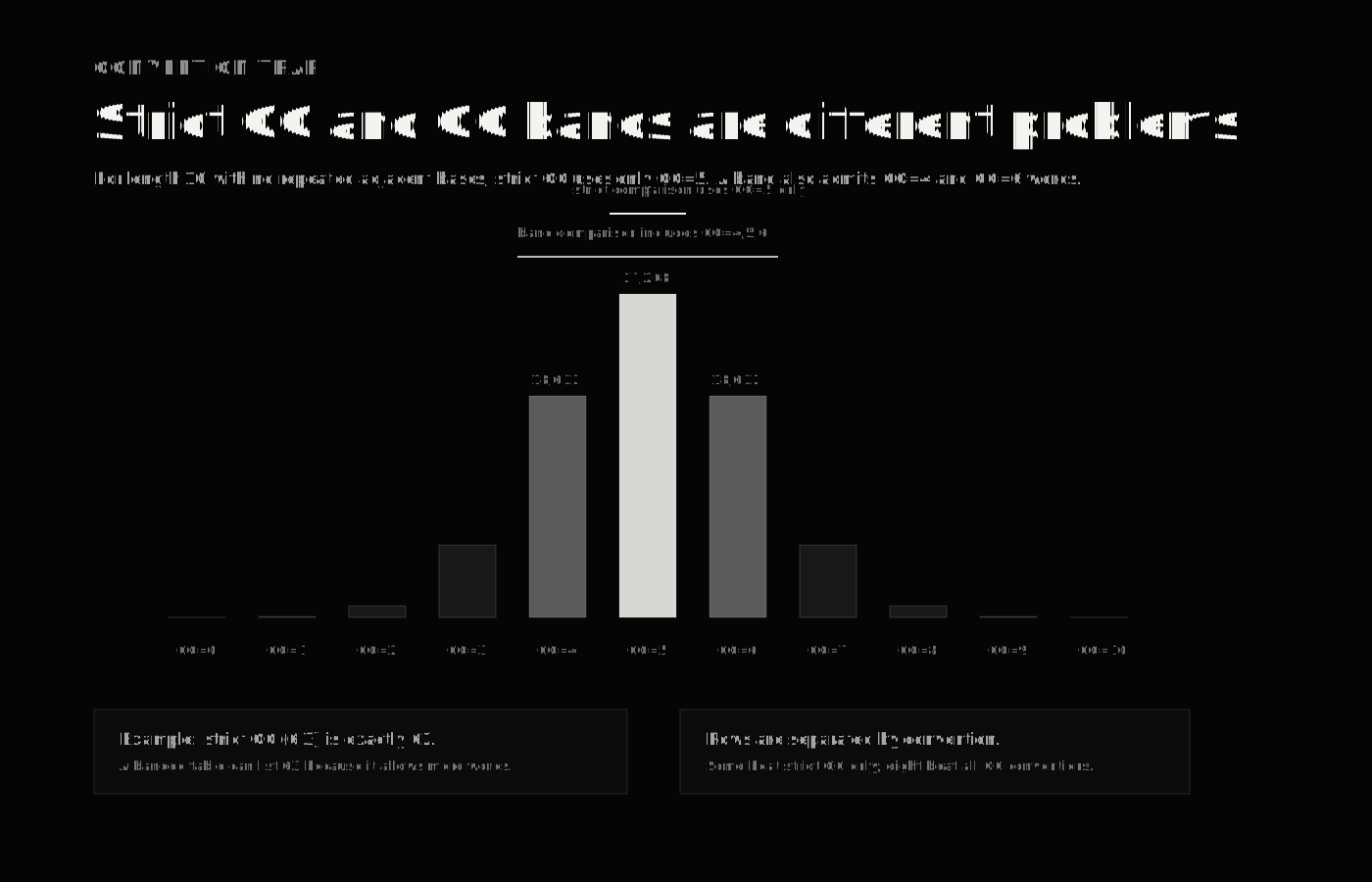
A DNA storage code is useful only if many words can be packed into the same constraint set. More words means more possible stored symbols at the same word length and error tolerance. The hard part is comparison: best-known is a literature claim, while optimal is a proof claim. This page separates those ideas and also separates strict GC from wider GC bands, because those are different problems.
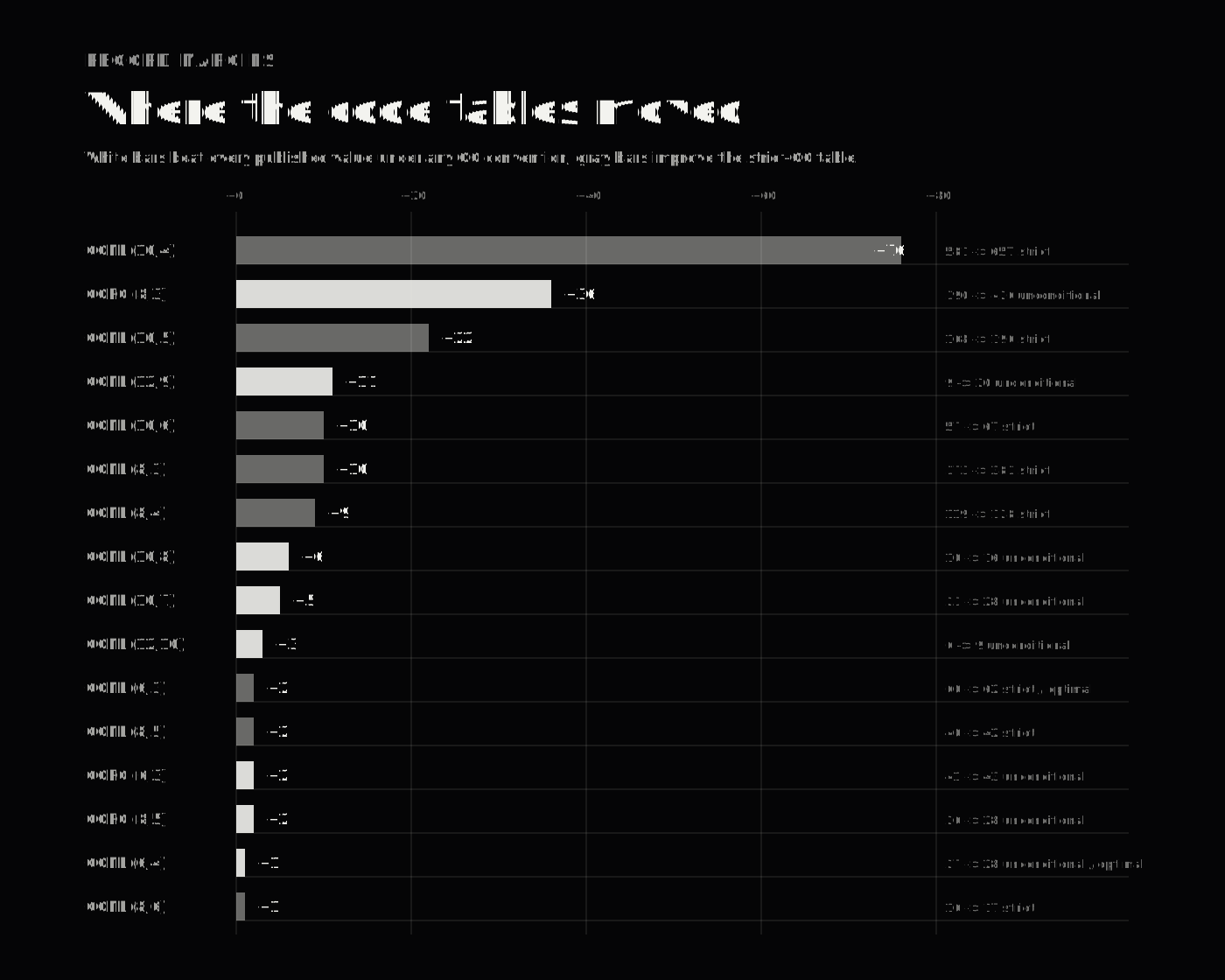
- The largest margin is GCNL (10,4): ROEAO's 581 to 657 under the strict-GC no-runlength/Hamming convention. CLGBO reports 580 for the same cell; Limbachiya's original value is 525.
- The largest all-convention row is King's reverse-complement (8,3): 390 to 426.
- IAOA's traditional GCNL table was checked explicitly: it raises the strict (6,3) baseline to 61, but does not erase any claimed row.
- Eight rows beat every published value under any GC convention. The remaining eight are strict-GC improvements only, and the table says so instead of blurring the comparison.
Visual notes
How to read the result
Result table
Sixteen DNA code-size improvements, with the baseline source named row by row.
| Cell | Baseline | Numaro | Delta | Note |
|---|---|---|---|---|
| GCNL (10,4) | 581 | 657 | +76 | strict GC; ROEAO source; CLGBO has 580 |
| GCRC (8,3) | 390 | 426 | +36 | all conventions; King source |
| GCNL (10,5) | 168 | 190 | +22 | strict GC; CLGBO source |
| GCNL (12,9) | 9 | 20 | +11 | all conventions; MFOS band source |
| GCNL (10,6) | 57 | 67 | +10 | strict GC; ROEAO source |
| GCNL (8,3) | 373 | 383 | +10 | strict GC; LEO/IAOA source |
| GCNL (8,4) | 119 | 128 | +9 | strict GC; LEO source |
| GCNL (10,8) | 10 | 16 | +6 | all conventions; ROEAO/IAOA/MFOS source |
| GCNL (10,7) | 23 | 28 | +5 | all conventions; CLGBO source |
| GCNL (12,10) | 6 | 9 | +3 | all conventions; MFOS band source |
| GCNL (6,3) | 61 | 62 | +1 | strict GC; IAOA Table 4 source; proven optimal |
| GCNL (8,5) | 40 | 42 | +2 | strict GC; LEO source; ties widest band |
| GCRC (6,3) | 41 | 43 | +2 | all conventions; King source |
| GCRC (8,5) | 26 | 28 | +2 | all conventions; King source |
| GCNL (6,4) | 27 | 28 | +1 | all conventions; ROEAO/MFOS source; proven optimal strict |
| GCNL (8,6) | 16 | 17 | +1 | strict GC; LEO/IAOA source |
Method
How it was found
Each cell becomes a graph problem. A vertex is an admissible DNA word. Two vertices are connected only if the two words can live in the same code. A large code is a large clique in that graph.
- Compiled the prior values from King, Limbachiya-Gupta-Aggarwal, NOL-HHO, CLGBO, EORS, QRSS-MPA, LEO, ROEAO, IAOA, and MFOS while recording the exact GC rule used by each source.
- Used ROEAO Table 5 only for the traditional S^GC,NL Hamming rows; its enhanced RTSC/DTW table is a different metric and is not used as a Hamming baseline.
- Used IAOA Table 4 only for the traditional A^GC,NL Hamming rows; its double-matching and error-pairing tables are extra-constraint families and are not used as Hamming baselines.
- Generated every admissible word for the requested length, distance, GC rule, and no-runlength or reverse-complement rule.
- Searched the compatibility graph with a bitmask clique solver; small cells were also closed with exact CP-SAT.
- Dropped apparent wins when the baseline used a wider GC band and the numbers were not comparable.
Verification
How it was checked
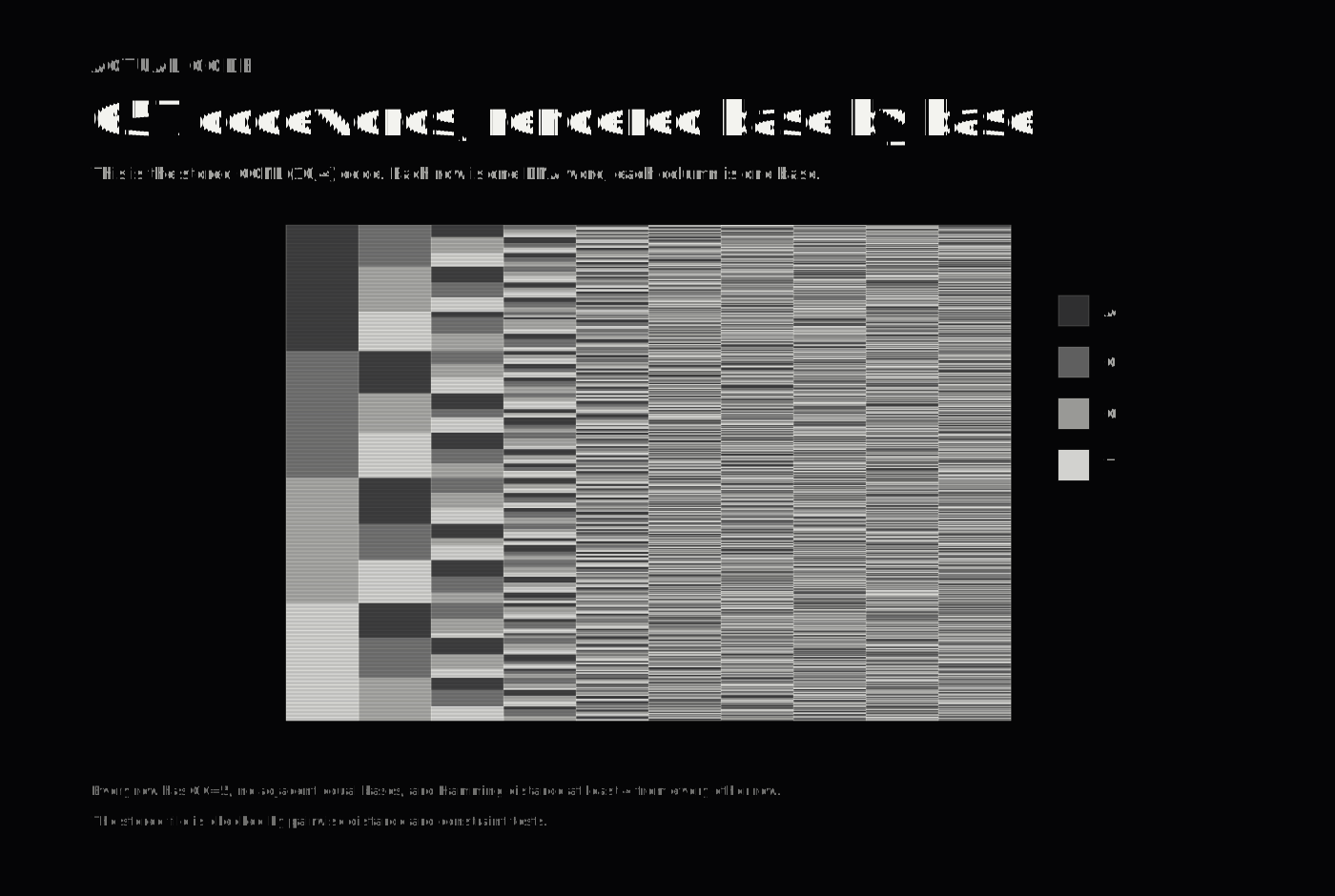
The checker rereads each saved code and tests the rules directly: every word has the right length and alphabet, the GC count is correct, no adjacent bases repeat where that rule applies, all words are distinct, every pair is far enough apart, and reverse-complement distances are checked for the reverse-complement family.
Scope
What is not being claimed
Only rows compared under the same convention are claimed. Best-known means larger than the published lower bounds we found for that matched constraint; optimal means proven no larger code exists. Most rows are best-known improvements, not optimality proofs. The proven-optimal statements are only for the strict-GC n=6 cells. Wider GC bands are a different, easier problem because they allow more candidate words.
References
Baseline sources
- King / GCRC baseline — Bounds for DNA codes with constant GC-content, 2003.
- LGA / Altruistic baseline — Limbachiya, Gupta, and Aggarwal, Family of Constrained Codes for Archival DNA Data Storage, IEEE Communications Letters 22(10):1972-1975, 2018.
- NOL-HHO — Yin et al., An Intelligent Optimization Algorithm for Constructing a DNA Storage Code: NOL-HHO, IJMS 21(6):2191, 2020.
- CLGBO — Zheng, Wu, and Wang, CLGBO: An Algorithm for Constructing Highly Robust Coding Sets for DNA Storage, Frontiers in Genetics 12:644945, 2021.
- EORS — Xiaoru and Ling, Combinatorial constraint coding based on the EORS algorithm in DNA storage, PLoS ONE 16:e0255376, 2021.
- QRSS-MPA — Yin, Zheng, Wang, and Zhang, Design of Constraint Coding Sets for Archive DNA Storage, IEEE/ACM TCBB, 2021.
- LEO — Zhang, Levy Equilibrium Optimizer algorithm for the DNA storage code set, PLoS ONE 17:e0277139, 2022.
- ROEAO — Li, Zhou, and Zou, Design of DNA Storage Coding with Enhanced Constraints, Entropy 24(8):1151, 2022.
- IAOA — Du et al., Study on DNA Storage Encoding Based IAOA under Innovation Constraints, Current Issues in Molecular Biology 45(4):3573-3590, 2023.
- MFOS — Rasool et al., Evolutionary approach to construct robust codes for DNA-based data storage, Frontiers in Genetics 14, 2023.
Citation
How to cite
Numaro AI Autoresearch Team. "DNA storage codes with larger codebooks." Numaro Research Report NUMARO-2026-011, 2026.
@techreport{numaro2026DnaStorageCodes,
  title = {DNA storage codes with larger codebooks},
  author = {Numaro AI Autoresearch Team},
  institution = {Numaro},
  number = {NUMARO-2026-011},
  year = {2026},
  url = {https://numaro.tech/research/dna-storage-codes-2026/}
}