Plain language
What this result means
The Fourier Entropy-Influence conjecture asks whether the Fourier spectrum of every Boolean function has entropy controlled by its sensitivity to input changes. No finite universal upper bound is known. An explicit function with a larger certified ratio therefore forces any valid universal constant upward. Here the improvement comes from a structural correction to the previous record, not from changing the influence or relaxing monotonicity.
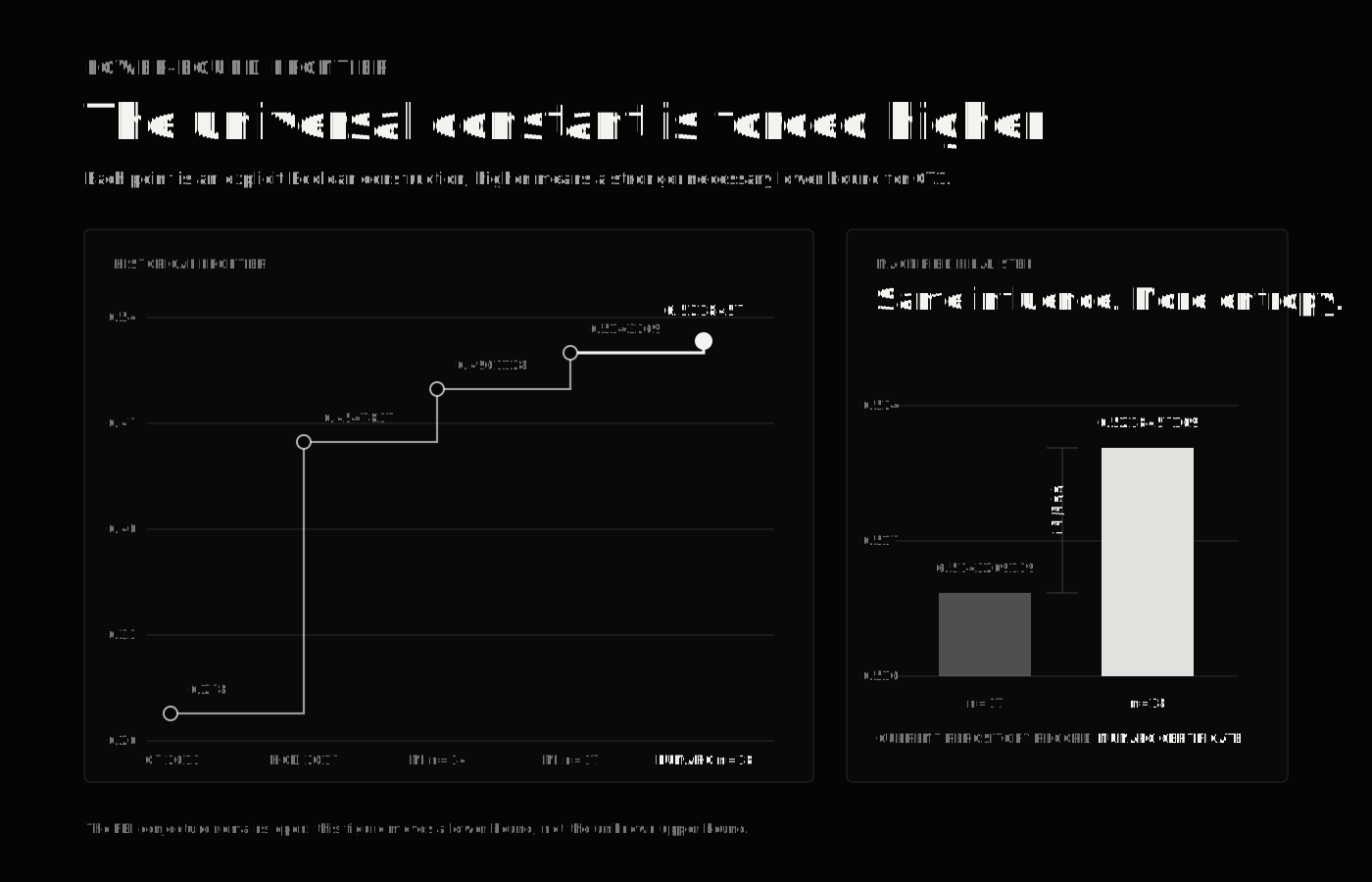
- Optimization Problems pull request #130 merged the n=18 certificate on August 2, 2026. The live constant page lists 6.521845710923046575 as the best established lower bound.
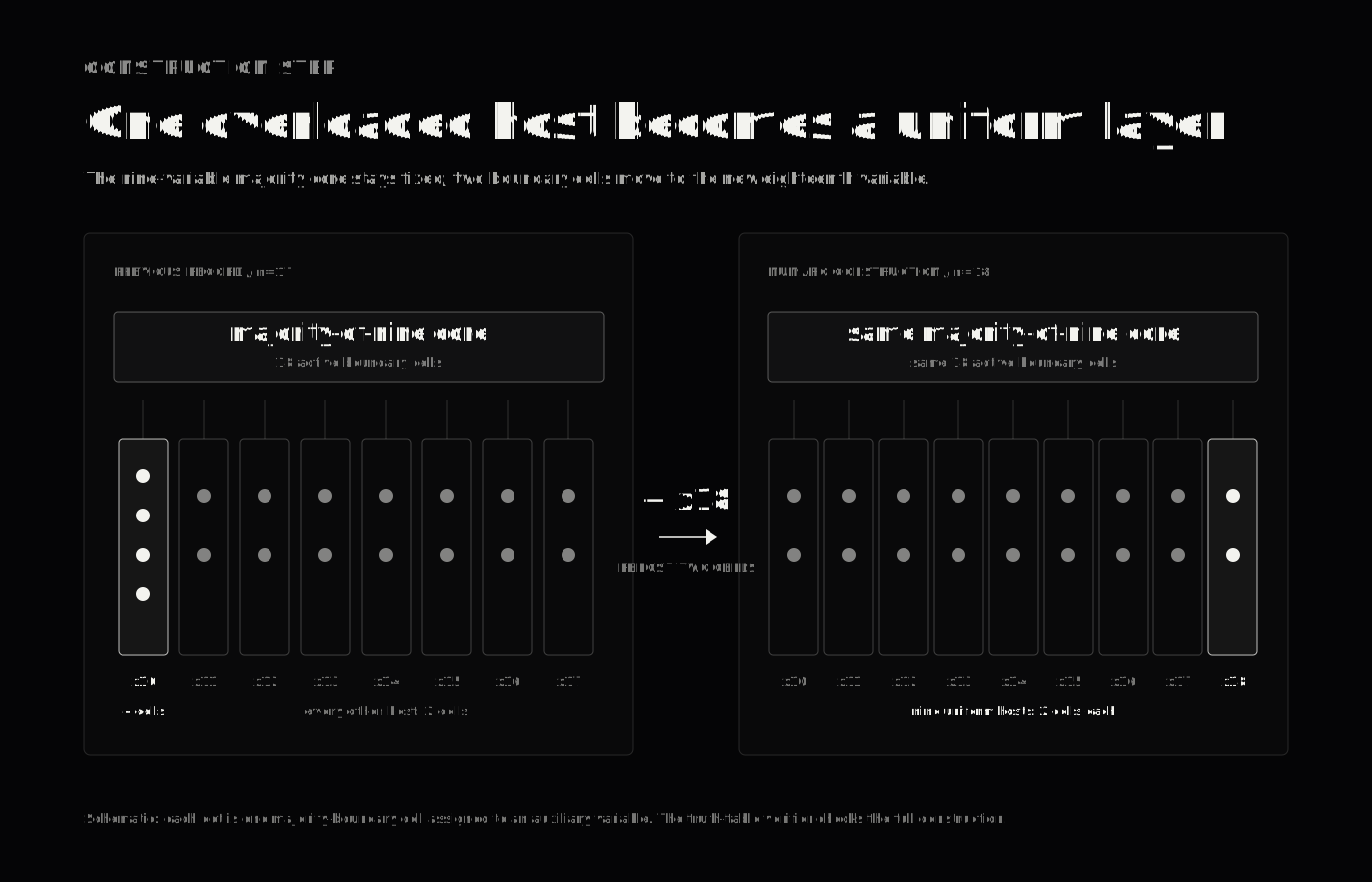
- The total influence remains exactly 261/128. The gain comes from increasing spectral entropy after splitting one four-cell auxiliary host into two uniform two-cell hosts.
- The truth table is exactly balanced and exhaustive monotonicity checking finds zero violations across all 2,359,296 coordinate edges.
- The included standalone checker and a separately written NumPy Walsh-Hadamard verifier both reproduce the strict beat from the published certificate.
The mathematical object
How one finite Boolean function forces a universal constant upward
Let be a Boolean function onn input bits. Write for the input indices and let select a subset of them. Every such function has a Fourier expansion in parity characters:
Here is an input, multiplies the coordinates indexed by , and is the corresponding Fourier coefficient. Parseval's identity makes the squared coefficients a probability distribution over subsets.
The spectral entropy is measured in bits. Total influence is the average Fourier level, equivalently the sum of the probabilities that each input coordinate changes the output. The FEI conjecture says is finite; that is still open. A larger explicit ratio does not prove the conjecture, but it raises the minimum value any valid universal constant must have.
A seed is balanced when it outputs each sign equally often, so . The new seed is also monotone under the standard coordinatewise Boolean order. The O'Donnell-Tan amplification rule turns that one finite truth table into a lower bound for the universal constant, including the restriction to monotone functions.
The first inequality is the certified interval lower endpoint. The second compares it with the previous record's certified upper endpoint, so the strict beat does not depend on rounded display digits.
Visual notes
How to read the result
Result table
A certified n=18 monotone construction raises the live lower bound by exactly 1/133.
| Cell | Baseline | Numaro | Delta | Note |
|---|---|---|---|---|
| FEI lower bound | 6.514326913930565372 | 6.521845710923046575 | +1/133 | strictly clears the previous certified upper endpoint |
| Seed dimension | n=17 | n=18 | +1 variable | 262,144-entry truth table |
| Total influence | 261/128 | 261/128 | unchanged | exact rational identity |
| Nonzero Fourier coefficients | 2,578 | 2,770 | +192 | recomputed from the truth table |
| Logic monotonicity | verified | verified | 0 violations | all 2,359,296 coordinate edges checked |
Method
How it was found
The construction keeps the previous record's perturbed majority-of-nine core and fixes an asymmetry in its auxiliary layer. At n=17, x10 acts on four core-boundary cells while each of the other seven auxiliaries acts on two. Adding x18 and moving two of x10's cells onto it produces nine two-cell hosts. The moved Fourier weight is split more evenly, increasing entropy while leaving total influence unchanged.
- Reproduced the merged MI2026b n=17 seed and its 261/128 exact influence.
- Separated the nine-variable majority core from the auxiliary-variable hosting map.
- Added x18 and rehosted two of x10's four boundary cells, producing a uniform two-cells-per-auxiliary layer.
- Scanned 16,838 single swap-freeze, relocate, and rehost moves; none improved the n=18 seed within that move class.
Verification
How it was checked
The published artifact encodes the full truth table as a hex bitmask and binds it to SHA-256 f8a7bb2c...7839. The self-contained checker and an independently written NumPy verifier rebuild all 262,144 values, compute the integer Walsh-Hadamard spectrum, assert Parseval and exact balance, derive I=261/128 as a Fraction, enclose spectral entropy with interval arithmetic, exhaustively check monotonicity, and compare the new lower endpoint against the previous record's certified upper endpoint. Both included checkers pass in local reruns.
Scope
What is not being claimed
This certified lower-bound update was merged into Optimization Problems and remains the best established lower bound listed there. It does not prove the FEI conjecture, provide a finite upper bound, or establish that the n=18 seed is globally optimal.
References
Baseline sources
- Davis, Ivanisvili, Tao, and contributors, Optimization Problems constant 71a.
- MI2026b, merged n=17 certificate and pull request #124.
- Numaro n=18 certificate, merged as pull request #130.
- O'Donnell and Tan, A Composition Theorem for the Fourier Entropy-Influence Conjecture.
- Hod, Improved Lower Bounds for the Fourier Entropy/Influence Conjecture via Lexicographic Functions.
- Numaro n=18 self-contained certificate checker.
- Numaro n=18 independent verifier.
- Numaro n=18 truth-table artifact.
- Numaro n=18 verification run log.
Citation
How to cite
Numaro AI Autoresearch. "A Certified n=18 Lower Bound for the Fourier Entropy-Influence Constant from AI Autoresearch." Numaro Research Report NUMARO-2026-016, 2026.
@techreport{numaro2026FourierEntropyInfluence,
  title = {A Certified n=18 Lower Bound for the Fourier Entropy-Influence Constant from AI Autoresearch},
  author = {Numaro AI Autoresearch},
  institution = {Numaro},
  number = {NUMARO-2026-016},
  year = {2026},
  url = {https://numaro.tech/research/fourier-entropy-influence-2026/}
}