Plain language
What this result means
A formula in the literature and an explicit object answer different verification needs. These witnesses let a reader inspect every selected vertex and every forbidden adjacency, then see exactly where the matching upper bound enters.
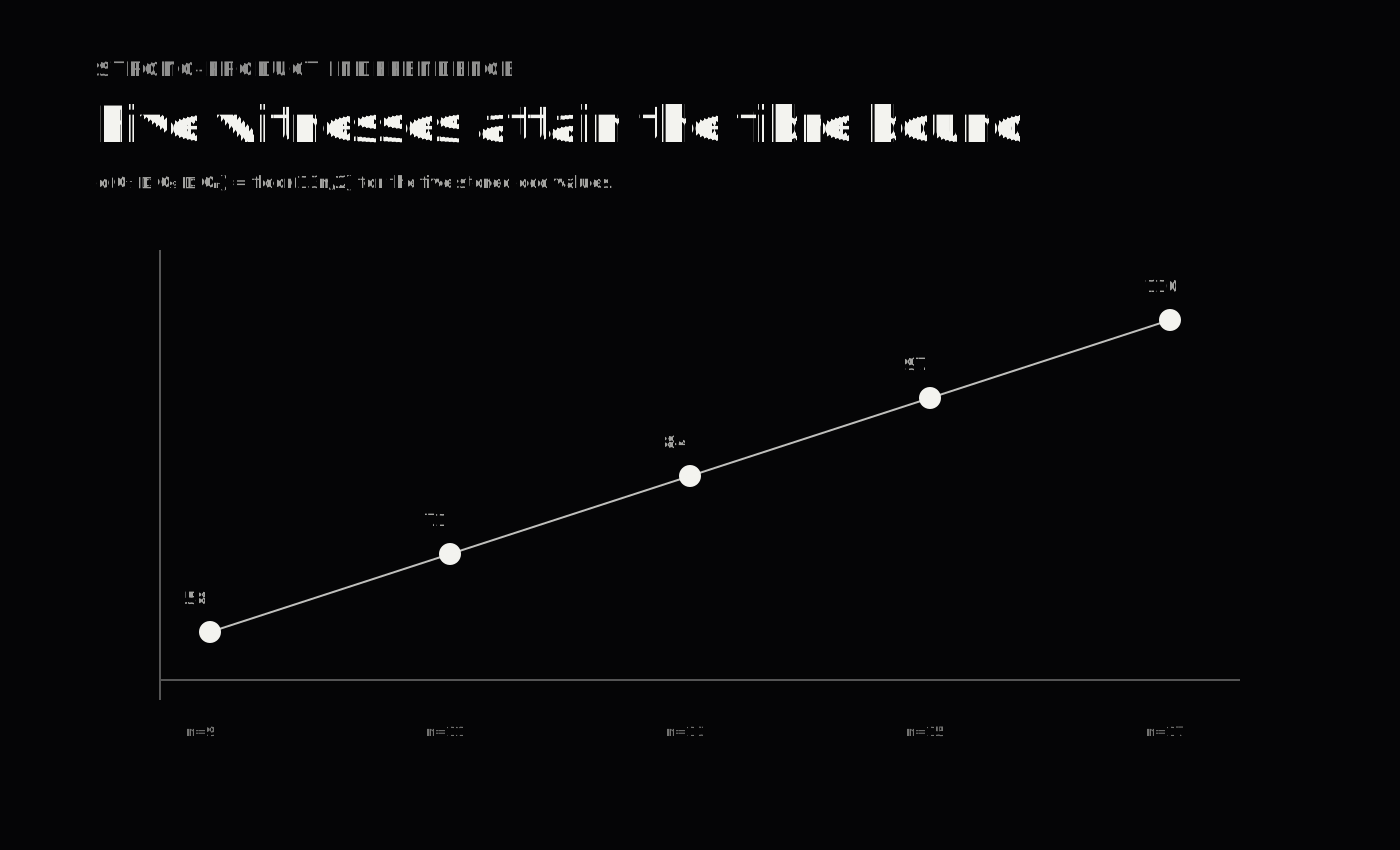
- The five witness sizes follow the linear sequence 13k+6 for n=2k+1 and k=4,…,8.
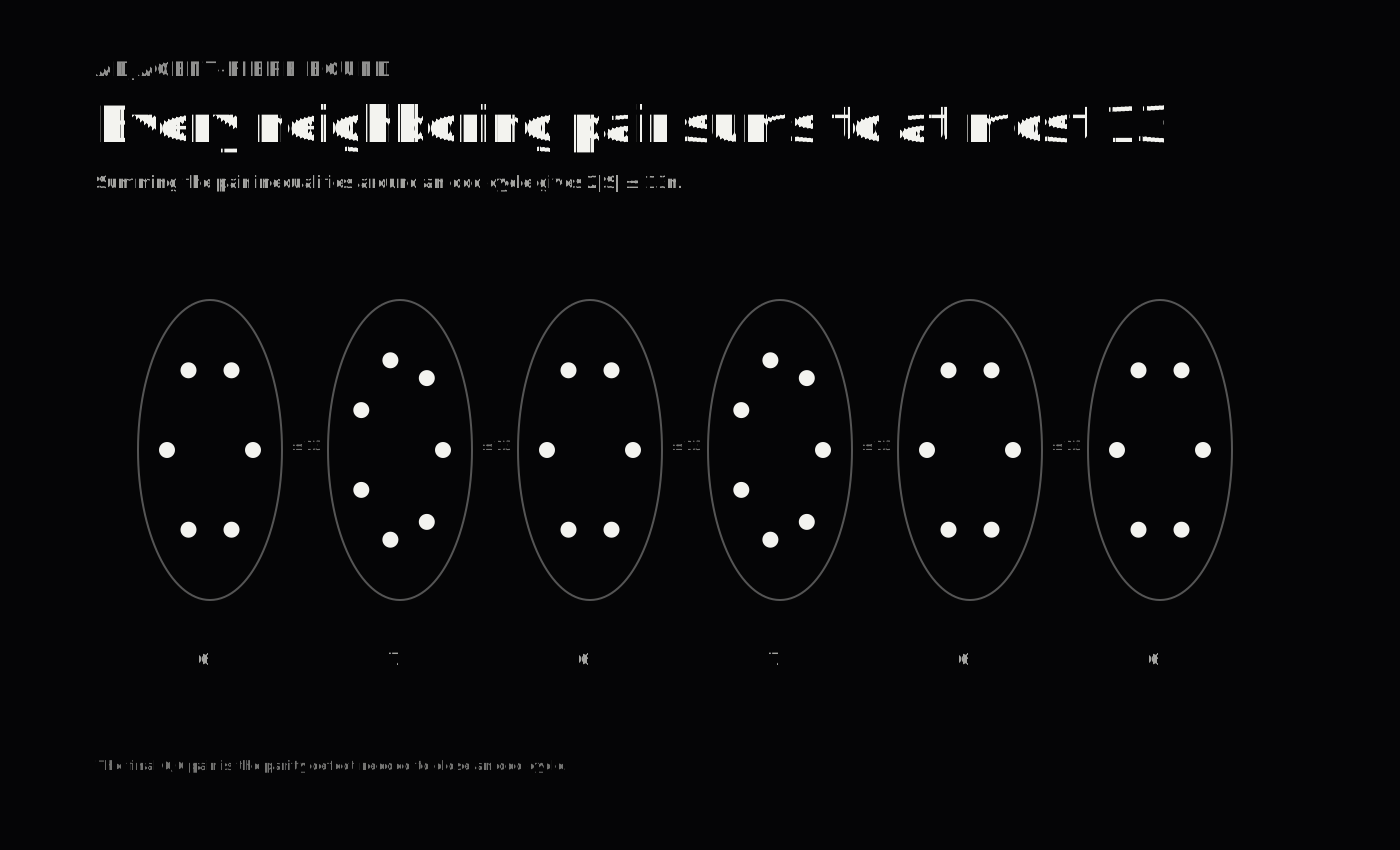
- For adjacent Cₙ fibres, the union of their selected vertices is independent in C₇ ⊠ C₉, so each adjacent pair contains at most 13 vertices.
- The source README treated the result as an open 2003 gap; the literature review found the exact family in Korže and Vesel's 2012 paper, so this page corrects that novelty claim.
Visual notes
How to read the result
Result table
Explicit independent sets attain the known fibre bound at sizes 58, 71, 84, 97, and 110.
| Cell | Baseline | Numaro | Delta | Note |
|---|---|---|---|---|
| C₇ ⊠ C₉ ⊠ C₉ | ≤58 | 58 | exact | explicit witness |
| C₇ ⊠ C₉ ⊠ C₁₁ | ≤71 | 71 | exact | explicit witness |
| C₇ ⊠ C₉ ⊠ C₁₃ | ≤84 | 84 | exact | explicit witness |
| C₇ ⊠ C₉ ⊠ C₁₅ | ≤97 | 97 | exact | explicit witness |
| C₇ ⊠ C₉ ⊠ C₁₇ | ≤110 | 110 | exact | explicit witness |
Method
How it was found
A constraint search assembled compatible independent subsets in successive Cₙ fibres, targeting alternating six- and seven-vertex layers with one parity defect around the odd cycle.
- Fixed the 63-vertex fibre graph C₇ ⊠ C₉ and its independence number 13.
- Enumerated compatible fibre subsets under strong-product adjacency.
- Searched for cyclic sequences attaining floor(13n/2).
- Exported each selected vertex triple as a standalone JSON witness.
Verification
How it was checked
The standalone checker confirms unique in-range vertices and tests every pair for strong-product adjacency. It also recomputes the adjacent-fibre inequality. All five witnesses pass and attain the supplied upper bound.
Scope
What is not being claimed
This is not a new independence-number theorem: the family appeared in Korže and Vesel in 2012. The bundled upper-bound check relies on the established fact α(C₇ ⊠ C₉)=13; the five JSON files independently certify the matching lower bounds.
References
Baseline sources
Citation
How to cite
Numaro AI Autoresearch. "Five machine-checkable optima for products of odd cycles." Numaro Research Report NUMARO-2026-021, 2026.
@techreport{numaro2026MixedOddCycle,
  title = {Five machine-checkable optima for products of odd cycles},
  author = {Numaro AI Autoresearch},
  institution = {Numaro},
  number = {NUMARO-2026-021},
  year = {2026},
  url = {https://numaro.tech/research/mixed-odd-cycle-products-2026/}
}