Plain language
What this result means
Adding two integer sets can collapse many pairs onto the same sums, while subtraction can keep more outcomes distinct. The GHR constant measures how large that separation can become when the sumset is still only a constant factor larger than the original set. A higher certified exponent means a stronger construction. Here one sparse digit pattern can be repeated to arbitrary depth, so a finite alphabet produces an asymptotic lower bound.
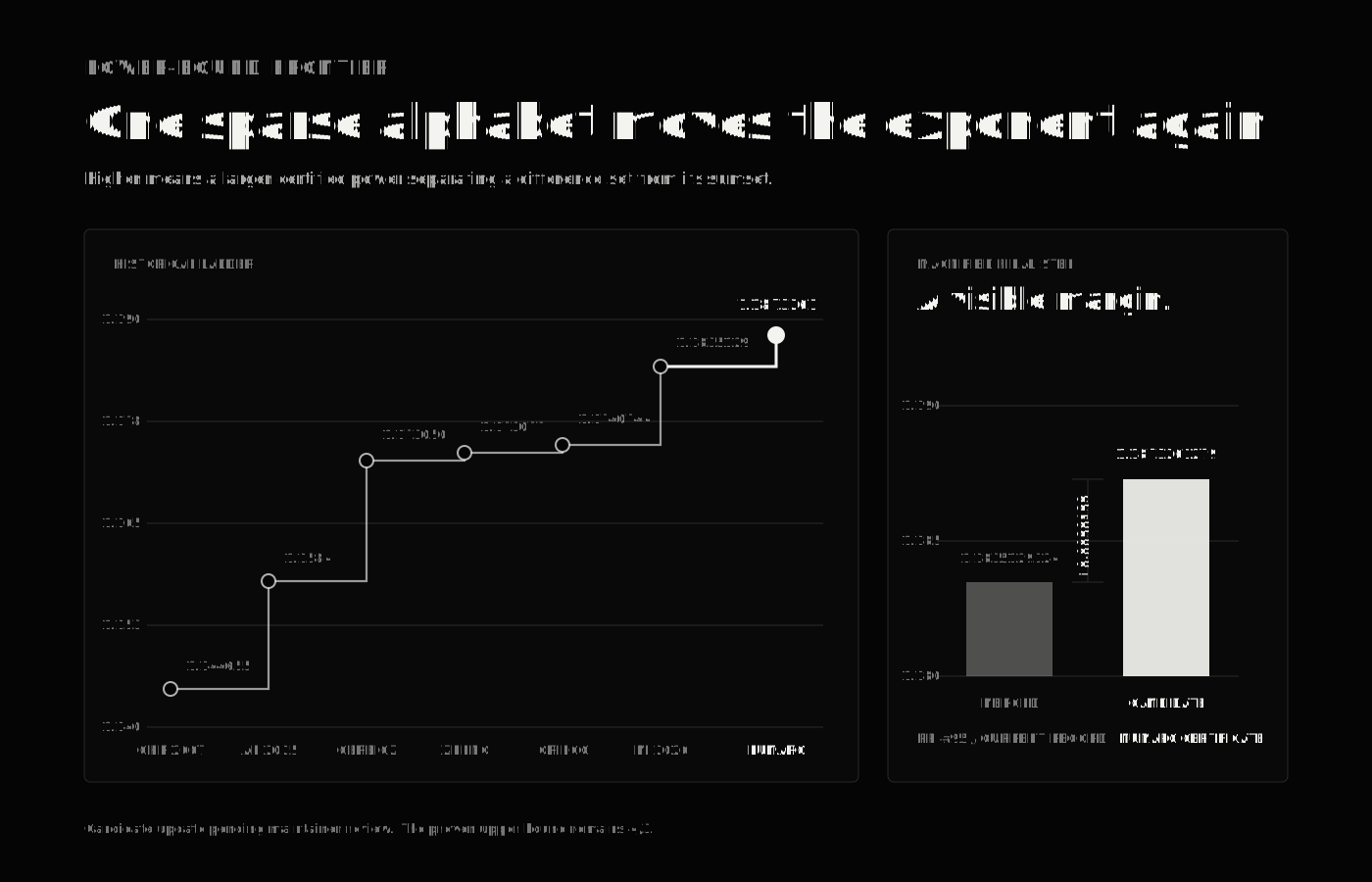
- The certificate cleared the full 1.1835129324 predecessor from pull request #95 and was merged in pull request #131. The live page now also records later, larger 2026 bounds.
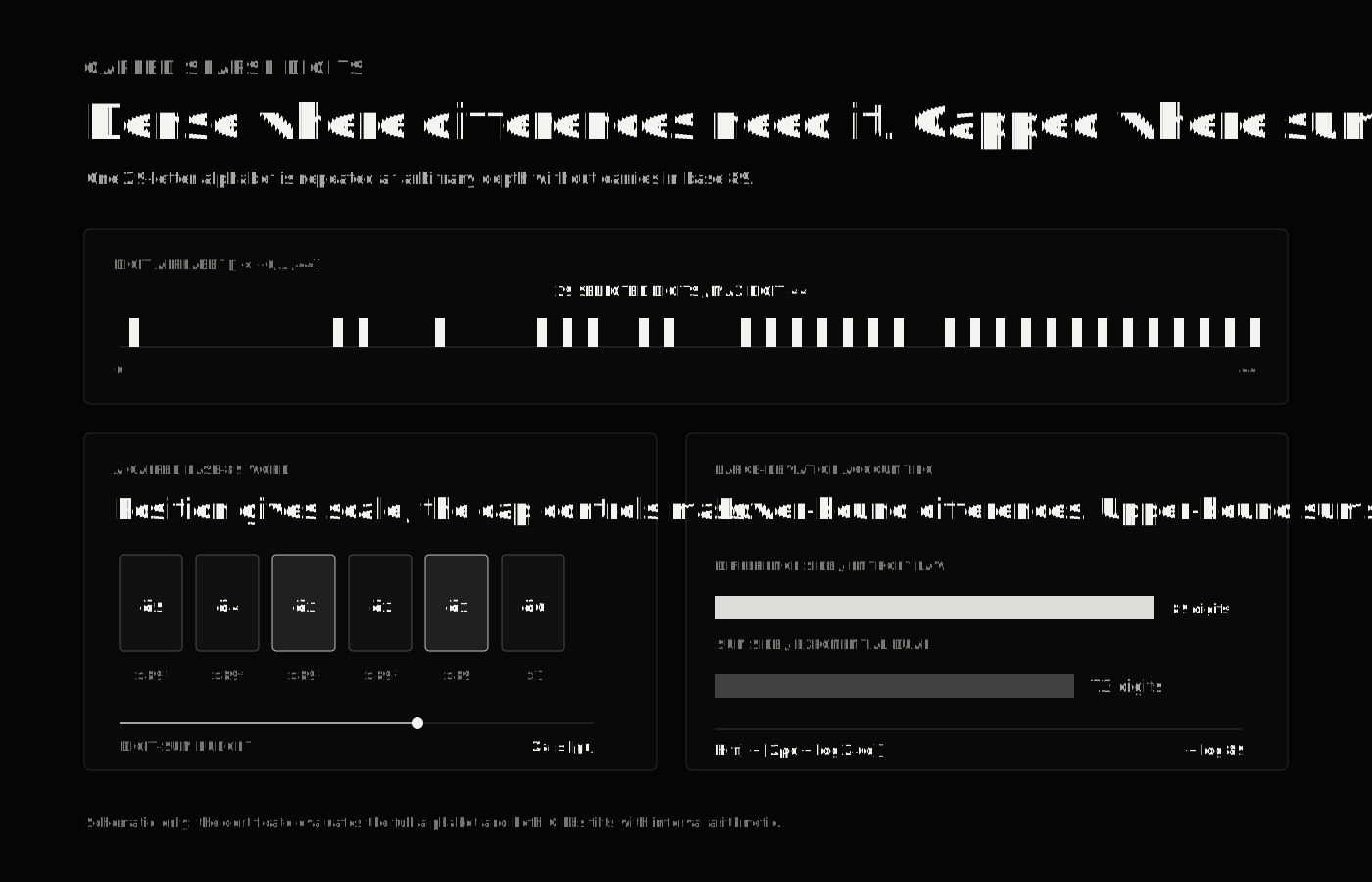
- The construction uses 29 digits from 0 through 44 in base 89, with cap ratio rho approximately 10.7041407995. Base 89 is exactly the carry-free boundary 2*44+1.
- The rigorous interval lower endpoint is 1.187326127925948057..., giving a certified margin of approximately 0.0038131955 over the merged record.
- Optimization Problems pull request #131 merged the certificate on July 31, 2026. Later 2026 constructions have since raised the listed lower bound further; the proven upper bound remains 4/3.
The mathematical object
How one digit alphabet creates asymptotically more differences than sums
For finite integer sets and , addition and subtraction produce the two derived sets
The constant is the largest exponent that can keep the sumset small while forcing the difference set to grow as a power of it. Here is any fixed number greater than one, and may depend on :
In the first step, is a finite set of nonnegative integers: counts its sums, counts its differences, and sets the projection scale. In the second, is the 29-digit alphabet, is the base, is the depth, and caps the average digit weight. Because , sums and differences have unique carry-free digit encodings.
The limit is certified with two exponential tilts. For each difference digit , let be the least-weight digit pair satisfying . The probability law supplies a feasible entropy lower bound for differences, while supplies a dual upper bound for sums:
The tilt is symmetric, so . Combining the entropy lower bound and the sum-side upper bound gives a rigorous limit inequality rather than an extrapolated numerical curve:
Interval arithmetic places the entire certified lower-bound interval above the previous record. The result remains below both the ceiling for this digit lemma and the proven upper bound for the constant.
Visual notes
How to read the result
Result table
A capped sparse-digit construction raises the certified lower bound by 0.0038131955.
| Cell | Baseline | Numaro | Delta | Note |
|---|---|---|---|---|
| C3a lower bound | 1.183512932421861510... | 1.187326127925948 | +0.0038131955 | strict interval separation |
| Construction | base 33, depth 420 | base 89, arbitrary depth | limit family | capped carry-free digits |
| Digit alphabet | 14 digits, max 16 | 29 digits, max 44 | +15 digits | dense upper tail, sparse lower tail |
| Digit-lemma ceiling | 5/4 | 5/4 | unchanged | construction stays safely below |
| Proven upper bound | 4/3 | 4/3 | unchanged | the global gap remains open |
Method
How it was found
The campaign searched sparse integer alphabets together with cap ratios and dual tilts, then isolated a difference-rich motif: a sparse lower region and a dense upper tail through 44. Repeating that alphabet in base 89 prevents carries. A Gibbs law on minimal digit pairs supplies a feasible entropy lower bound for difference words, while a second exponential tilt bounds the number of sum words. Directed interval arithmetic turns the two rates into a rigorous lower endpoint.
- Reproduced the current capped-digit construction family and its merged base-33 record.
- Searched sparse alphabets, cap ratios, and difference/sum tilt parameters under the no-carry constraint.
- Selected the 29-letter alphabet with maximum digit 44 and set the minimal carry-free base to 89.
- Certified the limiting growth inequality, then checked finite-depth counters against exact brute force on a tiny instance.
Verification
How it was checked
The permanent Zenodo archive contains the certificate data, construction notes, run log, and supplied standalone checker. That checker recomputes the tilted law, cap feasibility, the difference-growth admissibility bound, and the interval lower endpoint from gsd_3a_cert.json. It independently validates the finite-depth dynamic programs against brute force at depth 2 and prints genuine lower bounds at depths 4, 8, 12, and 16. A separately written local verifier reconstructs all minimal difference pairs and sum digits without importing the bundled code, obtains 89 difference digits and 73 sum digits, recomputes the full interval, and performs its own exact depth-2 set test. Both local runs end in PASS.
Scope
What is not being claimed
This certificate was incorporated into Optimization Problems in July 2026 but is no longer the largest lower bound listed there. It does not determine C_3a, improve the proven 4/3 upper bound, or prove that the base-89 alphabet is globally optimal.
References
Baseline sources
- Davis, Ivanisvili, Tao, and contributors, Optimization Problems constant 3a.
- Mosaic Intelligence, merged base-33 certificate and pull request #95.
- Numaro certificate, merged as Optimization Problems pull request #131.
- Gyarmati, Hennecart, and Ruzsa, Sums and Differences of Finite Sets.
- Zheng, Sums and Differences of Sets: A Further Improvement over AlphaEvolve.
- Gerbicz, Sums and Differences of Sets (Improvement over AlphaEvolve).
- Griego, base-21 construction and pull request #71.
- Numaro, permanent certificate archive for C_3a >= 1.187326, Zenodo. DOI: 10.5281/zenodo.21504058.
- Numaro base-89 certificate data.
- Numaro supplied certificate checker.
- Numaro independent certificate verifier.
- Numaro construction and verification notes.
- Numaro verification run log.
Citation
How to cite
Numaro AI Autoresearch. "A Certified Base-89 Lower Bound for the Gyarmati-Hennecart-Ruzsa Sum-Difference Constant from AI Autoresearch." Numaro Research Report NUMARO-2026-017, 2026.
Certificate archive: Zenodo, DOI 10.5281/zenodo.21504058.
@techreport{numaro2026SumDifferenceConstant,
  title = {A Certified Base-89 Lower Bound for the Gyarmati-Hennecart-Ruzsa Sum-Difference Constant from AI Autoresearch},
  author = {Numaro AI Autoresearch},
  institution = {Numaro},
  number = {NUMARO-2026-017},
  year = {2026},
  url = {https://numaro.tech/research/sum-difference-constant-2026/},
  note = {Certificate archive: Zenodo, DOI 10.5281/zenodo.21504058}
}